
A Century of Mining, Smelting and Refining Success but still Underexplored for Gold
The Flin Flon Greenstone Belt (the “FFGB”) is part of the Trans-Hudson Orogeny which was formed by arc volcanism during the Paleoproterozoic period. The FFGB is 250 km long by 75 km wide and is bounded by metasedimentary gneisses and metavolcanics of the Kisseynew Domain to the north and extends to the south where it is unconformably overlain by Ordovician age dolomite.
The FFGB is one of the highest-grade and most productive Paleoproterozoic Volcanogenic Massive Sulphide (“VMS”) districts (copper, gold, zinc, silver) in the world. VMS were first discovered in 1914 by prospector Tom Creighton and full production was achieved by 1930 under the control of Hudson Bay Mining and Smelting Company Limited. Over the last century 27 VMS deposits and over 183 million metric tonnes of massive sulfide ore have been mined. The VMS deposits were also rich in gold which was recovered as a by-product.
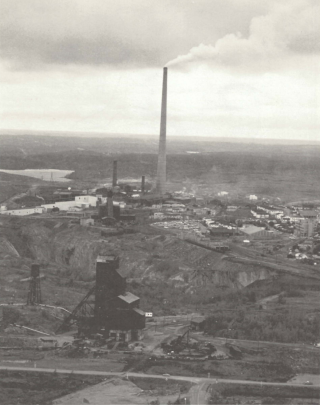
H.B.M. & S mining and metallurgical complex at Flin Flon.
(Canadian Mining Journal)
Despite the belt’s obvious mineral endowment, long history of mining, significant infrastructure, and politically safe jurisdiction it is not as well known on the world scale as other belts and it has not seen the same level of exploration for structurally controlled gold deposits as Canada’s other prolific greenstone belt, the Abitibi.
The Abitibi Greenstone Belt, a similarly endowed greenstone belt for VMS deposits, also hosts dozens of gold mines that have produced over 170 million ounces of gold since 1901. In contrast the FFGB belt has only 3 gold mines with production less than 2 million ounces.
The FFGB is under explored for structurally controlled gold deposits.
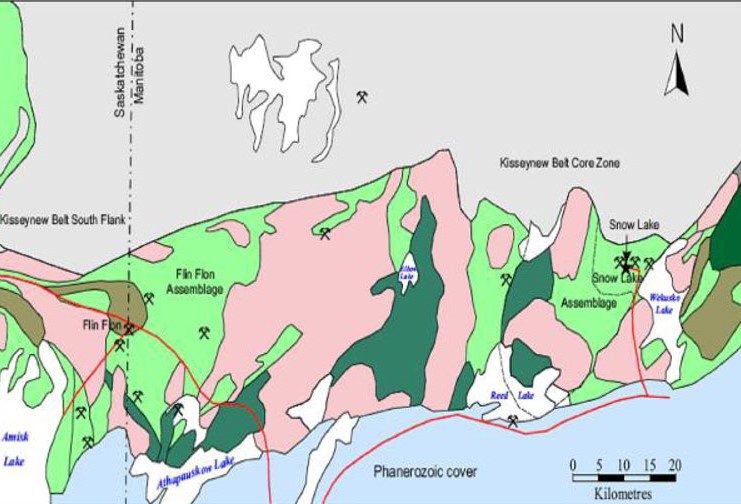
Minnova Corp. has yet to significantly expand its exploration drilling program to depths below one 600 meters. Our immediate focus has been to de-risk current PL Deposit and demonstrate the on-property exploration potential of the high-grade gold system along our 10-kilometre-long gold mineralized structures between PL deposit and the satellite Nokomis deposit.
We believe we have only barely scratched the surface and the district scale potential for new gold discoveries, beyond the PL Property, represents an incredible opportunity for Minnova Corp. transformational growth and discovery.
Minnova remains focused on becoming Manitoba’s and Canada’s next gold producer.
For more information on Gold in Manitoba please see the Province of Manitoba website’s Gold in Manitoba (PDF).